



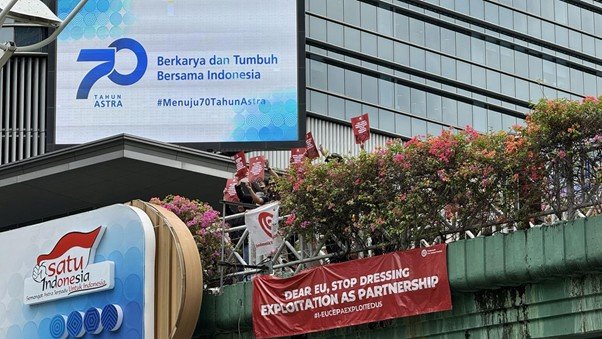
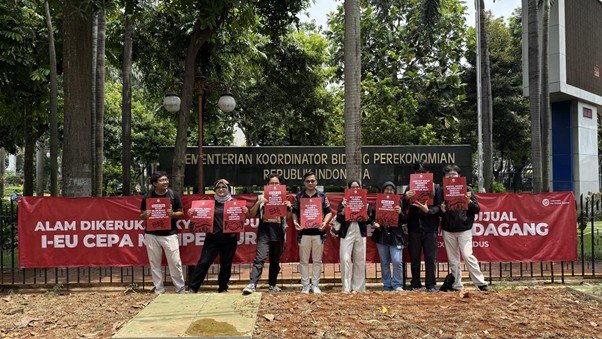
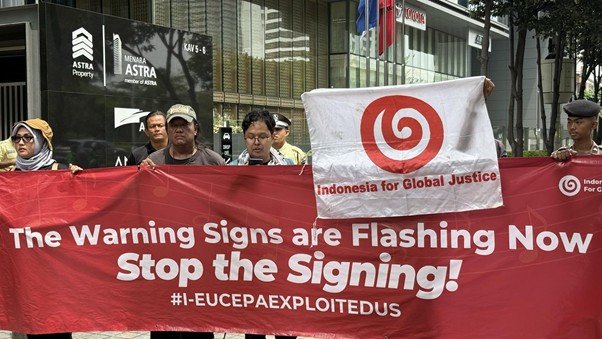
Jakarta, 20 November 2026 – Indonesia for Global Justice (IGJ) held a protest in front of the Delegation of the European Union to Indonesia and the Coordinating Ministry for Economic Affairs in Jakarta on Friday (20 November), ahead of the signing of the Indonesia–European Union Comprehensive Economic Partnership Agreement (I–EU CEPA), scheduled to take place on 21 November 2026 in Brussels, Belgium.
The protest represents civil society’s opposition to a trade agreement with far-reaching implications for the economic, social, and environmental conditions, as well as the rights of the Indonesian people, yet negotiated without transparency or meaningful public participation. IGJ considers that the Indonesian government has prioritised concluding the trade agreement with the European Union without ensuring that all commitments contained in it are consistent with national interests and the constitutional mandate.
Rahmat Maulana Sidik, Executive Director of Indonesia for Global Justice (IGJ), stated that the protest in front of the EU Delegation and the Coordinating Ministry for Economic Affairs symbolised opposition to both the process and the substance of an agreement that could restrict Indonesia’s economic sovereignty.
“This protest is directed at both the European Union and the Indonesian Government, as the parties negotiating and agreeing to the commitments under this trade agreement. We object to negotiations conducted behind closed doors, as well as a signing process lacking transparency and meaningful public participation. An agreement with far-reaching implications must not be treated solely as a matter for governments and business interests, while the people who will bear its consequences are excluded from the process,” Maulana stressed
Maulana
I–EU CEPA Is Not Merely a Trade Agreement, but an Instrument That Could Restrict National Policy Space
IGJ emphasises that I–EU CEPA should not be viewed merely as an instrument to increase market access and trade volumes. The agreement contains various commitments that could affect the state’s ability to regulate industry, manage natural resources, protect farmers, ensure access to medicines, and implement development policies that serve the public interest.
According to IGJ’s analysis, one of the fundamental problems with I–EU CEPA is the imbalance of interests between Indonesia as a developing country and the European Union as an advanced economic power. Through various commitments on trade liberalisation and investment protection, Indonesia risks losing policy space to develop its national industrial base, strengthen economic self-reliance, and protect strategic sectors.
“The issue is not simply whether Indonesia will gain greater access to the European market. The more fundamental question is whether Indonesia will retain the freedom to determine its own economic development priorities after being bound by various commitments under I–EU CEPA. Under the banner of free trade, Indonesia must not lose the policy instruments needed to protect national industries, manage natural resources, and fulfil people’s rights,” Maulana stated.
Maulana
In the agricultural sector, I–EU CEPA would commit Indonesia to implementing plant variety protection provisions aligned with the standards of UPOV 1991 (International Convention for the Protection of New Varieties of Plants). The implementation of these standards would restrict farmers’ ability to use, save, develop, and exchange seeds, while strengthening the position of multinational seed corporations.
Agung Prakoso, Researcher at Indonesia for Global Justice (IGJ), stated:
“I–EU CEPA could bind Indonesia to the UPOV 1991 plant variety protection standards, which placegreateremphasisontheexclusiverightsofbreedersandtheinterestsoftheseedindustry. As a result, Indonesian farmers could become increasingly dependent on seeds supplied by corporations, while the use and preservation of local seeds couldbe undermined,” Agung stated.
Indonesia is also committed to strengthening intellectual property protection through the introduction of pharmaceutical data exclusivity, which could reinforce pharmaceutical monopolies and undermine competition from generic medicines.
Agung Prakoso further emphasised, “Intellectual property provisions in I–EU CEPA, such as data exclusivity, could obstruct the production of generic medicines because generic manufacturers would be prevented from relying on existing clinical trial data. This could undermine Indonesia’s ability to ensure the availability and affordability of medicines,” Agung said
Critical Mineral Downstreaming at Risk: Indonesia Could Remain a Supplier of Raw Materials
In the industrial and critical minerals sectors, IGJ considers that I–EU CEPA does not provide adequate guarantees for strengthening national industrial capacity, particularly in technology transfer, research development, value addition, and the development of technological capabilities within domestic industries. Through I–EU CEPA, Indonesia risks being further locked into the position of a raw material supplier for the European Union’s industrial supply chains.
Putri Rahmayati, Researcher at Indonesia for Global Justice (IGJ), stated: “The European Union needs critical mineral supplies to support its energy transition and industrial agendas. However, the EU is not subject to binding obligations to transfer technology to Indonesian industries. If this pattern continues, Indonesia risks being trapped once again in an extractive economic model,” Putri Rahmayati explained
Putri Rahmayati
I–EU CEPA’s Digital Trade Provisions Could Threaten Data Sovereignty and Strengthen Digital Corporations
IGJ also highlights Chapter 10 on Digital Trade in I–EU CEPA, which regulates cross-border data flows, data localisation, and the disclosure of source code. These provisions could narrow Indonesia’s policy space to regulate data, develop national digital infrastructure, and build its domestic technology industry.
Restrictions on data localisation requirements risk increasing Indonesia’s dependence on digital infrastructure and cloud computing services owned by multinational technology corporations. Meanwhile, restrictions on source code disclosure could create challenges for technology oversight and regulatory enforcement. Indonesia risks becoming merely a market and a source of data, while control over technology and the economic value generated by the digital economy remain concentrated in global corporations.
Muhamad Aryanang Isal, Researcher at Indonesia for Global Justice (IGJ), stressed:
“Digital trade must not become a gateway for global technology corporations to dominate Indonesia’s data and digital infrastructure. When the state’s policy space to regulate data flows and build domestic technological capacity is increasingly restricted, our digital sovereignty is at stake. Indonesia must not become merely a market and a source of data, while the economic gains and control over technology are captured by multinational corporations,” Anang stressed.
Anang
I–EU CEPA’s Palm Oil Protocol: No Guarantee of Market Access; Domestic Governance Must Be Reformed
The Palm Oil Protocol under I–EU CEPA should not be regarded as a guarantee of exports or assured access for Indonesian palm oil to the European Union market. The protocol primarily provides for dialogue, information exchange, and cooperation to help businesses meet sustainability requirements for trade. In other words, it does not automatically remove EU regulatory barriers or guarantee that Indonesian palm oil products will be accepted in the European market.
The government must not present this protocol as a diplomatic trade achievement without ensuring tangible benefits for farmers and communities. The priority should instead be to reform domestic palm oil governance by resolving agrarian conflicts, protecting the rights of smallholder farmers and Indigenous Peoples, ending deforestation, strengthening supply chain traceability, and enforcing environmental and labour standards. Without such reforms, trade cooperation risks benefiting large business actors disproportionately, while smallholder farmers bear the burden of certification and compliance with sustainability standards.
Cahaya Arga Putri Diponegoro, Researcher at Indonesia for Global Justice (IGJ), stated: “The Palm Oil Protocol must not become merely a diplomatic instrument to create new trade opportunities while failing to guarantee the protection of farmers, Indigenous Peoples, and the environment. The government must reform palm oil governance rather than simply pursue export market access through trade agreement mechanisms,” Cahaya stated.
Cahaya Arga Putri Diponegoro
IGJ also raises concerns over proposals to ratify I–EU CEPA through a Presidential Regulation rather than through an Act of Parliament. Such a proposal would undermine the constitutional rights of the public, further closing off opportunities for public participation. The House of Representatives (DPR) should exercise its constitutional authority to challenge this approach.
Muhamad Aryanang Isal, Researcher at Indonesia for Global Justice (IGJ), reiterated: “The House of Representatives must fulfil its constitutional role by scrutinising, critically examining, and ensuring that every international commitment is consistent with national interests and the constitutional rights of the people. If I–EU CEPA has far-reaching implications for people’s lives and reduces the state’s policy space, its ratification must be conducted democratically, transparently, and in accordance with the Constitution. The DPR can even reject trade agreements that undermine national interests. It must therefore take an active role in conducting a comprehensive assessment of I–EU CEPA,” Anang stated.
Muhamad Aryanang Isal
In light of these concerns, we are demands for the following actions:
- Halt the signing of I–EU CEPA and reopen a comprehensive review of all commitments under the agreement before the government binds Indonesia to long-term international trade obligations.
- Conduct a comprehensive impact assessment of I–EU CEPA, particularly its implications for national industrialisation, food sovereignty, digital sovereignty, access to medicines, environmental protection, the rights of Indigenous Peoples, and the economic interests of the people.
- Reject trade commitments that threaten farmers’ rights and public access to healthcare, including the adoption of UPOV 1991 standards that restrict farmers’ seed practices and pharmaceutical data exclusivity provisions that could undermine competition from generic medicines.
- Ensure transparency and meaningful public participation in all decision-making processes concerning international trade and investment agreements.
Media Contact:
Agung Prakoso, Researcher of Indonesia for Global Justice (IGJ)
Email: agung.prakoso@igj.or.id
About Indonesia for Global Justice (IGJ)
Indonesia for Global Justice is a civil society organisation focusing on globalisation, free trade agreements, and investment agreements and their implications for farmers, fishers, workers, the environment, and public health. For more information, visit: www.igj.or.id
Siaran Pers
Related IGJ Publications on I–EU CEPA:
- Analysis Paper: The Intellectual Property Chapter in I–EU CEPA – More for Europe, Less for Indonesia (21 February 2026)
- I–EU CEPA: Who Controls Indonesia’s Critical Minerals? (17 December 2025)
- The Threat of I–EU CEPA to the Environment, Indigenous Peoples, and Biodiversity (4 December 2024)
- Press Release: I–EU CEPA Negotiations Hijack Democratic Rights and Ignore Impacts on Communities (3 July 2024)
- Reminding the Government and Negotiators of Their Commitment Not to Bind Indonesia to UPOV Membership or Amend Relevant Plant Protection Laws and Regulations (23 April 2024)
- Indonesia–EU CEPA Negotiations Must Be Halted to Prioritise People’s Economic Sovereignty and Human Rights (9 December 2023)
- I–EU CEPA Negotiations Are Not for Small Farmers and Vulnerable Communities (13 July 2023)
- Indonesian Civil Society Coalition for Economic Justice Calls for an End to I–EU CEPA Negotiations over Risks of a Multi-Dimensional Crisis (9 February 2023)
- Without Public Participation, I–EU CEPA Negotiations Risk Triggering a Multi-Dimensional Crisis in Indonesia (9 February 2023)
- More Than 90 International Civil Society Organisations Urge the EU to Remove TRIPS-Plus Provisions from the Indonesia–EU CEPA (11 November 2021)